
ISTQB CTFL v4.0 - Certified Tester Foundation Level (CTFL) v4.0 Exam
Page: 2 / 5
Total 202 questions
Question #51 (Topic: Exam A)
Determining the schedule for each testing activity and test milestones for a test project, using activity estimates, available resources, and other constraints is a typical task performed during:
A. Test execution.
B. Test design.
C. Test analysis.
D. Test planning.
Question #52 (Topic: Exam A)
A requirement specifies that if the total amount of sales (TAS) made during the year by a corporate seller is 300,000€ or more, the bonus that must be paid to the seller is 100% of a certain amount agreed upon at the beginning of the year. The software contains a fault as it implements this requirement with the decision "IF (TAS = 300,000)" instead of "IF (TAS >= 300,000)". The application of the 3-value boundary value analysis to this problem consists of the following three test cases (TAS is an integer variable):
TC1 = 299,999
TC2=300,000
TC=300,001
Which of the following statements is TRUE?
TC1 = 299,999
TC2=300,000
TC=300,001
Which of the following statements is TRUE?
A. TC1 would highlight the fault.
B. TC2 would highlight the fault.
C. TC3 would highlight the fault.
D. None of the three test cases would highlight the fault.
Question #53 (Topic: Exam A)
A document describes the test procedures that have been derived for the identified test sets. Among other things, the order in which the test cases in the corresponding test set are to be executed according to the dependencies described by preconditions and postconditions is specified. This document is a typical work product produced as part of:
A. Test design.
B. Test analysis.
C. Test implementation.
D. Test monitoring and control.
Question #54 (Topic: Exam A)
Which of the following types of tools is BEST suited for determining source code compliance with the guidelines provided by a coding standard?
A. Containerization tool.
B. Fault seeding tool.
C. Static analysis tool.
D. Test data preparation tool.
Question #55 (Topic: Exam A)
Which of the following statements about traceability is FALSE?
A. Traceability between test basis items and the test cases designed to cover them, makes it possible to determine which test basis items have been covered by the executed test cases.
B. Traceability between test basis items and the test cases designed to cover them, enables experience-based test techniques to be applied.
C. Traceability between test basis items and the test cases designed to cover them, enables identification of which test cases will be affected by changes to the test basis items.
D. Traceability can be established and maintained through all the test documentation for a given test level, such as from test conditions through test cases to test scripts.
Question #56 (Topic: Exam A)
Which of the following is a typical potential risk of using test automation tools?
A. Reduced feedback times regarding software quality compared to manual testing.
B. Reduced test execution times compared to manual testing.
C. Reduced repeatability and consistency of tests compared to manual testing.
D. Underestimation of effort required to maintain test scripts.
Question #57 (Topic: Exam A)
A typical generic skill required for the role of tester is the ability to:
A. Take on the role of developer to meet challenging project deadlines.
B. Assume leadership aimed at imposing decisions on the rest of the team.
C. Use tools to make the execution of repetitive testing tasks more efficient.
D. Determine the corrective actions to get a test project on track in case of deviations from the test plan.
Question #58 (Topic: Exam A)
As a tester, as part of a V-model project, you are currently executing some tests aimed at verifying if a mobile app asks the user to grant the proper access permissions during the installation process and after the installation process. The requirements specification states that in both cases the app shall ask the user to grant access permissions only to the camera and photos stored on the device. However, you observe that the app also asks the user to grant access permission to all contacts on the device. Consider the following items:
[I]. Test environment.
[II]. Expected result.
[III]. Actual result.
[IV]. Test level.
[V]. Root cause.
Based on only the given information, which of the items listed above, are you able to CORRECTLY specify in a defect report?
[I]. Test environment.
[II]. Expected result.
[III]. Actual result.
[IV]. Test level.
[V]. Root cause.
Based on only the given information, which of the items listed above, are you able to CORRECTLY specify in a defect report?
A. [I] and [II].
B. [II] and [III].
C. [II], [III] and [V].
D. [I], [IV] and [V].
Question #59 (Topic: Exam A)
Which of the following statements refers to a good testing practice that applies to all software development lifecycles?
A. Each test level should have its own specific test objectives that should be consistent with the software development lifecycle phase or type of activities it addresses.
B. Test analysis and design for any test levels should begin as soon as coding is complete, and all system components are available for testing.
C. The most efficient and effective method of conveying information to and within a development team is face-to-face conversation.
D. All the tests should be automated and run as part of the continuous integration process with every software change.
Question #60 (Topic: Exam A)
The following decision table is used to assist a doctor in determining the drug therapy to prescribe for a patient (aged 6 to 65 years) diagnosed with acute sinusitis. The table consists of three Boolean conditions and six actions:
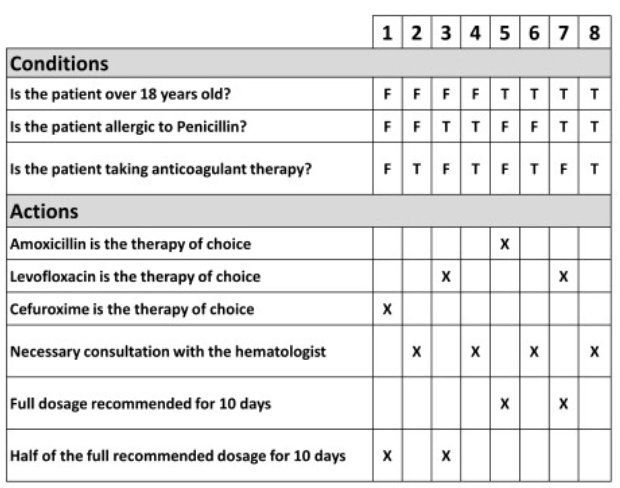
Based only on the given information, which of the following statements is TRUE?
Based only on the given information, which of the following statements is TRUE?
A. Column 7 represents an impossible situation and thus can be deleted.
B. Columns 1 and 3 can be merged into a single column.
C. Columns 2, 4, 6 and 8 can be merged into a single column.
D. Columns 5 and 7 can be merged into a single column.
Question #61 (Topic: Exam A)
Which of the following statements about TDD, BDD and ATDD is TRUE?
A. Refactoring is a practice that is an integral part of TDD and is applied both to tests and to code written to satisfy those tests.
B. ATDD is a black-box test design technique that is applicable exclusively at acceptance test level.
C. BDD is a developer practice where business stakeholders are not usually involved as the tests are directly written at unit/component test level.
D. ATDD is the practice of running the automated acceptance tests as part of a continuous integration process.
Question #62 (Topic: Exam A)
An anti-intrusion system is battery powered and is activated by pressing the only available button. To deactivate the system, the operator must enter a PIN code. The system will stay in alert mode within a configurable timeout and an alarm bell will ring if the system is not deactivated before the timeout expires. The following state transition diagram describes the behavior of the system:
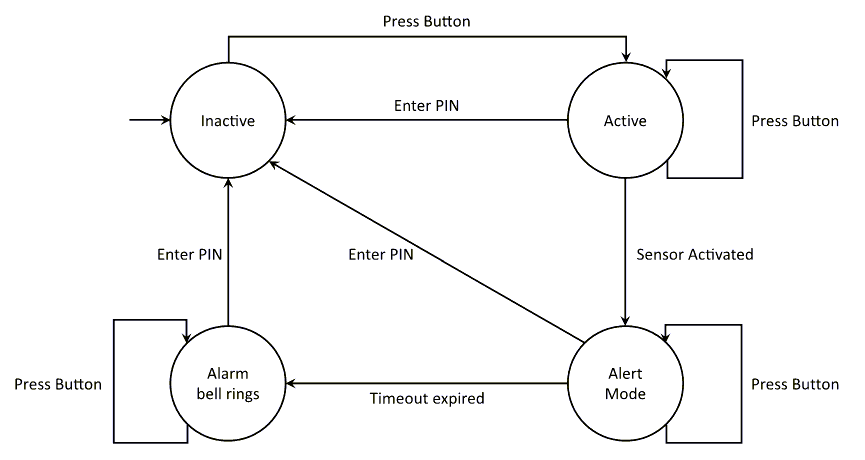
What is the minimum number of test cases needed to cover every unique sequence of exactly 4 states / 3 transitions starting and ending in the “Inactive” state? (note that “Inactive” is not a final state in the diagram).
What is the minimum number of test cases needed to cover every unique sequence of exactly 4 states / 3 transitions starting and ending in the “Inactive” state? (note that “Inactive” is not a final state in the diagram).
A. 1
B. 2
C. 3
D. 4
Question #63 (Topic: Exam A)
Which of the following statements is TRUE?
A. Unlike functional testing, non-functional testing can only be applied to conventional systems, not artificial intelligence-based system.
B. Functional testing focuses on what the system is supposed to do, while white-box testing focuses on how well the system does what it is supposed to do.
C. Functional testing can be applied to all test levels, while non-functional testing can be applied only to system and acceptance test levels.
D. Black-box test techniques and experience-based test techniques may be applicable to both functional testing and non-functional testing.
Question #64 (Topic: Exam A)
Consider the following user story about an e-commerce website's registration feature that only allows registered users to make purchases:
“As a new user, | want to register to the website, so that | can start shopping online”
The following are some of the acceptance criteria defined for the user story:
[a] The registration form consists of the following fields: username, email address, first name, last name, date of birth, password and repeat password.
[b] To submit the registration request, the new user must fill in all the fields of the registration form with valid values and must agree to the terms and conditions.
[c] To be valid, the email address must not be provided by free online mail services that allow to create disposable email addresses. A dedicated error message must be presented to inform the new user when an invalid address is entered.
[d] To be valid, the first name and last name must contain only alphabetic characters and must be between 2 and 80 characters long. A dedicated error message must be presented to inform the new user when an invalid first name and/or the last name is entered.
[e] After submitting the registration request, the new user must receive an e-mail containing the confirmation link to the e-mail address specified in the registration form.
Based only on the given information, which of the following ATDD tests is MOST LIKELY to be written first?
A. The new user enters valid values in the fields of the registration form, except for the email address, where he/she enters an e-mail address provided by a free online mail service that allow to create disposable email addresses. Then he/she is informed by the website about this issue.
B. The new user enters valid values in the fields of the registration form, except for the first name, where he/she enters a first name with 10 characters that contains a number. Then he/she is informed by the website about this issue.
C. The user accesses the website with a username and password, and successfully places a purchase order for five items, paying by Mastercard credit card.
D. The new user enters valid values in all the fields of the registration form, confirms to accept all the terms and conditions, submits the registration request and then receives an e-mail containing the confirmation link to the e-mail address specified in the registration form.
Question #65 (Topic: Exam A)
After being in operation for many years, a document management system must be decommissioned as it has reached its end of life. This system will not be replaced by any other new system. A legal obligation provides that all documents within the system must be kept for at least 20 years in a state archive. Which of the following statements about maintenance testing for decommissioning of this system is TRUE?
A. No maintenance testing is required as this system will not be replaced.
B. Data migration testing is required as part of maintenance testing.
C. Confirmation testing is required as part of maintenance testing.
D. Regression testing is required as part of maintenance testing.
Question #66 (Topic: Exam A)
Which of the following statements about the test pyramid is TRUE?
A. Each layer of the test pyramid groups tests related to a single non-functional quality characteristic.
B. The higher the layer of the test pyramid, the more production code a single automated test within the layer tends to cover.
C. The higher the layer of the test pyramid, the more maintainable a single automated test within the layer tends to be.
D. The higher the layer of the test pyramid, the more isolated a single automated test within the layer tends to be.
Question #67 (Topic: Exam A)
Which of the following statements about retrospectives is TRUE?
A. Only developers and testers should be involved in retrospectives, as involving people in other roles is very likely to prevent developers and testers from having open and constructive discussions that really help identify process improvements.
B. Retrospectives can be very effective in identifying process improvements and can also be very efficient and cost-effective especially since, unlike reviews, they do not require any follow-up activities.
C. On Agile projects, well-conducted retrospectives at the end of each iteration can help the team reduce and sometimes even eliminate the need for daily stand-up meetings.
D. During retrospectives, in addition to identifying relevant process improvements, participants should also consider how to implement these improvements and retain them based on the context of the project, such as the software development lifecycle.
Question #68 (Topic: Exam A)
Which of the following about typical information found within a test plan is FALSE?
A. The need to temporarily have additional test personnel available for specific test phases and/or test activities.
B. The conditions that must be met in order for the test execution activities to be considered completed.
C. The list of the product risks which have not been fully mitigated at the end of test execution.
D. The conditions that must be met for part of all the planned activities to be suspended and resumed.
Question #69 (Topic: Exam A)
Which of the following statements about the shift-left approach is FALSE?
A. The shift-left approach can only be implemented with test automation.
B. The shift-left approach in testing is compatible with DevOps practices.
C. The shift-left approach can involve security vulnerabilities.
D. The shift-left approach can be supported by static analysis tools.
Question #70 (Topic: Exam A)
Which of the following statements about the testing quadrants is TRUE?
A. The higher the number of the testing quadrant, the more important the tests associated with this quadrant are.
B. Automated acceptance tests produced during BDD and ATDD are classified in quadrant Q2.
C. Exploratory tests are classified in quadrant Q3, and they are usually included in a continuous integration process.
D. Automated unit tests produced during TDD are classified in quadrant Q4 as they are technology facing.
Question #71 (Topic: Exam A)
Which of the following is a role that is usually responsible for documenting the findings (e.g., action items, decisions, recommendations) made by the review team as part of a typical formal review?
A. Review leader.
B. Facilitator.
C. Recorder.
D. Moderator.
Question #72 (Topic: Exam A)
Consider the following examples of risks identified in different software development projects:
[I]. It may not be possible to generate the expected workloads to run performance tests, due to the poor hardware equipment of the machines (load injectors) that should generate these workloads.
[II]. A user's session on a web application is not invalidated after a certain period of inactivity (configured by the system administrator) of the user.
[III]. The test team will not have an adequate requirements specification (since many requirements will still be missing) by the time test design and analysis activities should begin according to the test plan.
[IV]. Following a failure, the system is unable to continue to maintain its pre-failure operation and some data becomes corrupted.
Which of the following statements is TRUE?
A. [II] and [IV] are product risks; [I] and [III] are project risks.
B. [II] and [III] are product risks; [I] and [IV] are project risks.
C. [I], and [IV] are product risks; [II] and [III] are project risks.
D. [I], [II] and [III] are product risks; [IV] is a project risk.
Question #73 (Topic: Exam A)
Which of the following is a factor that contributes to a successful review?
A. All participants in the review are aware they will be evaluated based on the defects they will find.
B. The author of the work product to be reviewed leads the review meeting.
C. All participants in the review are trained to deal with the review type and its objectives.
D. Review metrics must be collected to improve the review process.
Question #74 (Topic: Exam A)
A test status report SHOULD:
A. Specify the impediments to carrying out the planned test activities in the reporting period and the corresponding solutions put in place to remove them.
B. Be produced as part of test completion activities and report unmitigated product risks to support the decision whether or not to release the product.
C. Always be based on the same template within an organization, as its structure and contents should not be affected by the audience to which the report is presented.
D. Specify the lines of communication between testing, other lifecycle activities, and within the organization that were chosen at the outset of the test project.
Question #75 (Topic: Exam A)
Which of the following statements about static testing and dynamic testing is TRUE?
A. Static testing is better suited than dynamic testing for highlighting issues that could indicate inappropriate code modularization.
B. Dynamic testing can only be applied to executable work products, while static testing can only be applied to non-executable work products.
C. Both dynamic testing and static testing cause failures, but failures caused by static testing are usually easier and cheaper to analyze.
D. Security vulnerabilities can only be detected when the software is being executed, and thus they can only be detected through dynamic testing, not through static testing.
Question #76 (Topic: Exam A)
From a testing perspective, configuration management:
A. Allows the expected results to be compared with the actual results.
B. Allows the tracking of all changes to versions of the testware.
C. Includes all activities that direct and control an organization with regard to quality.
D. Focuses on configuring static analysis tools to choose the most suitable breadth and depth of analysis.
Question #77 (Topic: Exam A)
Which of the following statements about the typical activities of a formal review process is TRUE?
A. Individual review is only mandatory when the size of the work product under review is too large to cover at the review meeting.
B. Various review techniques that may be applied by participants during individual review are described in the ISO/IEC/IEEE 29119-3 standard.
C. Choosing which standards to follow during the review process is usually made during review planning.
D. One of the main goals of the review meeting is to make sure that all participants are aware of their roles and responsibilities in the review process.
Question #78 (Topic: Exam A)
Consider an estimation session in which a six-member Agile team (Mempb1, ..., Memb6) uses the planning poker technique to estimate a user story (in story points). The team members will use a set of cards with the following values: 1, 2, 3, 5, 8, 13, 21. Below is the outcome of the first round of estimation for this session:
Memb1 = 3 Memb2 = 3 Memb3 = 3
Memb4 = 21 Memb5 = 3 Memb6 = 1
Which of the following answers BEST describes how the estimation session should proceed?
Memb1 = 3 Memb2 = 3 Memb3 = 3
Memb4 = 21 Memb5 = 3 Memb6 = 1
Which of the following answers BEST describes how the estimation session should proceed?
A. The final estimate of the user story in story points is determined by applying the three-point estimation technique with the following input values: most optimistic estimate = 1, most likely estimate = 3, and most pessimistic estimate = 21.
B. Further estimation rounds should be performed until all team members will pick the card having the same value: this value will represent the final estimate of the user story in story points.
C. The final estimate of the user story in story points is determined by calculating the average value between the most optimistic estimate of 21 story points (Memb4) and the most pessimistic estimate of 1 story point (Memb6).
D. Memb6 and Memb4 which have produced the most pessimistic and the most optimistic estimates respectively, should explain the reasons of their choices to stimulate a discussion between all members before proceeding to another estimation round.
Question #79 (Topic: Exam A)
Which of the following answers describes a reason for adopting experience-based testing techniques?
A. Experience-based test techniques provide more systematic coverage criteria than black-box and white-box test techniques.
B. Experience-based test techniques completely rely on the tester’s past experience for designing test cases.
C. Experience-based test techniques allow designing test cases that are usually easier to reproduce than those designed with black-box and white-box test techniques.
D. Experience-based test techniques tend to find defects that may be difficult to find with black-box and white-box test techniques and are often useful to complement these more systematic techniques.
Question #80 (Topic: Exam A)
For each test case to be executed, the following table specifies its dependencies and the required configuration of the test environment for running such test case:
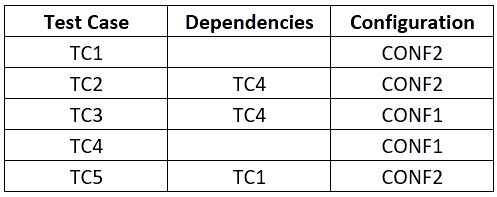
Assume that CONF1 is the initial configuration of the test environment. Based on this assumption, which of the following is a test execution schedule that is compatible with the specified dependencies and allows MINIMIZING the number of switches between the different configurations of the test environment?
Assume that CONF1 is the initial configuration of the test environment. Based on this assumption, which of the following is a test execution schedule that is compatible with the specified dependencies and allows MINIMIZING the number of switches between the different configurations of the test environment?
A. TC4, TC3, TC2, TC1, TC5.
B. TC1, TC5, TC4, TC3, TC2.
C. TC4, TC3, TC2, TC5, TC1.
D. TC4, TC1, TC5, TC2, TC3.
Question #81 (Topic: Exam A)
Which of the following statements about white-box testing is FALSE?
A. Static testing can benefit from using code-related white-box test techniques during code reviews.
B. White-box testing allows suggesting test cases for increasing coverage levels which are based on objective measures.
C. Achieving full code coverage for a component or a system ensures that it has been fully tested.
D. Black-box testing can benefit from using code-related white-box test techniques to increase confidence in the code.
Question #82 (Topic: Exam A)
Which of the following statements about statement coverage is TRUE?
A. Achieving 90% statement coverage ensures that 90% branch coverage is achieved.
B. Achieving 100% statement coverage ensures that no variable within the code has been used without being initialized.
C. Achieving 100% statement coverage ensures that 100% branch coverage is achieved.
D. Achieving 80% statement coverage ensures that 80% of all executable statements within the code have been exercised.
Question #83 (Topic: Exam A)
The following decision table is an excerpt of a larger decision table used to assist a doctor in determining the drug therapy to prescribe for a patient (aged 6 to 65 years) diagnosed with acute sinusitis. The table consists of four Boolean conditions and six actions:
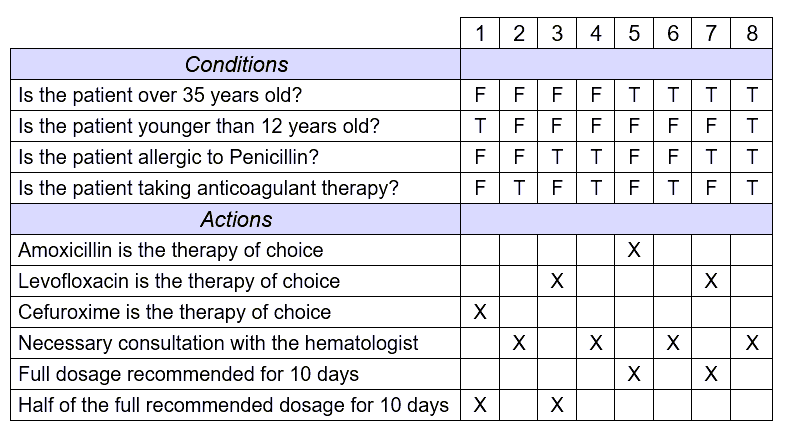
Based only on the given information, which of the following represent an impossible situation?
Based only on the given information, which of the following represent an impossible situation?
A. 7
B. 1
C. 8
D. 3
Question #84 (Topic: Exam A)
An anti-intrusion system is battery powered and is activated by pressing the only available button. To deactivate the system, the operator must enter a PIN code. The system will stay in alert mode within a configurable timeout and an alarm bell will ring if the system is not deactivated before the timeout expires. The following state transition diagram describes the behavior of the system:
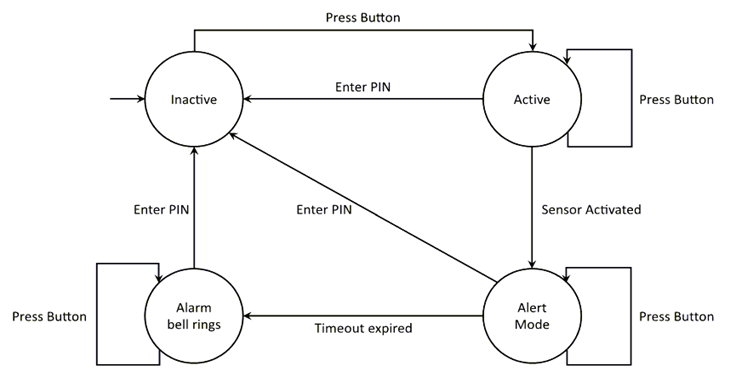
Assume that each test case has the following form, in which states are indicated in quotation marks and transitions in square brackets: “State 1”, [Transition 1], “State 2”, [Transition 2], …, “State N-1”, [Transition N-1], “State N”.
Which of the following test cases, in addition to being valid, covers all states with minimal effort?
A. “Inactive”, [Press Button], “Active”, [Sensor Activated], “Alert Mode”, [Timeout expired], “Alarm bell rings”
B. “Inactive”, [Enter PIN], “Active”, [Sensor Activated], “Alert Mode”, [Timeout expired], “Alarm bell rings”
C. “Inactive”, [Press Button], “Active”, [Press Button], “Active”, [Sensor Activated], “Alert Mode”, [Timeout expired], “Alarm bell rings”
D. “Inactive”, [Press Button], “Active”, [Sensor Activated], “Alert Mode”, [Press Button], “Alert Mode”, [Timeout expired], “Alarm bell rings”
Question #85 (Topic: Exam A)
Consider the following test-related items (1, 2, 3, 4) and four testing quadrants (Q1, Q2, Q3, Q4):
1. Security tests
2. Examples
3. Component integration tests
4. Exploratory tests
Q1: technology facing, supporting the development team
Q2: business facing, supporting the development team
Q3: business facing, critique the product
Q4: technology facing, critique the product
How do the specified test-related items map onto the four testing quadrants?
A. 1-Q3, 2-Q2, 3-Q1, 4-Q4
B. 1-Q4, 2-Q2, 3-Q1, 4-Q3
C. 1-Q1, 2-Q2, 3-Q3, 4-Q4
D. 1-Q4, 2-Q1, 3-Q2, 4-Q3
Question #86 (Topic: Exam A)
You are a tester working on a critical project. Based on the risk analysis you need to decide on the order of test execution. Which of the following lists the correct sequence of test execution? Priority 1 is the highest and Priority 3 is the lowest priority.
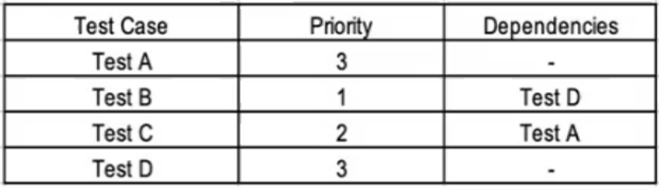
A. D-С-В-A
B. C-B-A-D
C. D-A-B-C
D. D-B-A-C
Question #87 (Topic: Exam A)
You are a test manager responsible for implementing risk-based testing in your organization which deals with software in the healthcare domain. You are writing a handbook of various product risk mitigation options. Which ONE of the following options correctly represent the correct mitigation options?
A. Choosing a tool for automated unit testing to reduce the risks
B. Using a third-party testing company to transfer the risk to that company
C. Selecting a tester with required knowledge related to compliance and standards
D. Increasing the number of testers to be able to take care of all the risks
Question #88 (Topic: Exam A)
Which of the following statements about impact of DevOps on testing is CORRECT?
A. DevOps helps shift focus of operations people to functional testing
B. DevOps helps shift focus of testing people to perform operations testing
C. DevOps helps eliminate manual testing by having focus on continuous automated testing
D. DevOps helps bring focus on testing of non-functional characteristics
Question #89 (Topic: Exam A)
Which sequence of state transitions is INCORRECT in accordance with the following description?
To provide for disaster recovery a system (designated as A) has been provided with a backup system (designated as B). Only one of them can be active at a time. When A goes down, В becomes active. When A comes back up then В becomes inactive and A becomes active again. However, when A is down and В also goes down then a message is sent to the system administrator. After this once A comes back up, A becomes active or if В comes up then В becomes Active.
To provide for disaster recovery a system (designated as A) has been provided with a backup system (designated as B). Only one of them can be active at a time. When A goes down, В becomes active. When A comes back up then В becomes inactive and A becomes active again. However, when A is down and В also goes down then a message is sent to the system administrator. After this once A comes back up, A becomes active or if В comes up then В becomes Active.
A. A is active and В is inactive A goes down. В becomes active then В goes down. A is made active
B. A comes up when В is active and A was down Now A becomes active and В becomes inactive
C. A is active and В is inactive then A goes down В becomes active
D. A and В are both down then A and В both come back up at the same time A should become the active system and В should be inactive
Question #90 (Topic: Exam A)
In a review which of the following is the responsibility of the manager?
A. Performing detailed review based on past experience
B. Organizing the logistics of the review meeting
C. Ensuring that sufficient time is available for review
D. Measuring the performance of each reviewer
Question #91 (Topic: Exam A)
What does the "absence-of-defects fallacy" refer to in software development?
A. The idea that fixing defects is NOT important to meeting user needs
B. The need for constant system quality assurance and improvements.
C. A misconception that software verification is unnecessary
D. The belief that thoroughly testing all requirements guarantees system success
Question #92 (Topic: Exam A)
Given some statements about independence of testing
i. Independence is a replacement for familiarity with the code
ii. Independence helps remove the biases produced because of own work
iii. Similar kind of failures can be detected by anyone
iv. Assumptions by different people are different revealing weaknesses
Which of the following CORRECTLY represents the benefits?
A. ii and iv
B. iii and iv
C. i and iii
D. i and iv
Question #93 (Topic: Exam A)
In branch testing, what is the significance of a conditional branch in a software program?
A. It signifies a comment or documentation within the code and it doesn’t indicate a defect
B. It marks a point where the program’s execution will terminate bringing the program to a halt
C. It indicates a decision point where the program can follow different paths based on specific conditions
D. It represents a programming error and therefore a conditional branch should be avoided
Question #94 (Topic: Exam A)
For a given set of test-cases, which of the following is a benefit of running these tests with a test automation tool?
A. Test coverage is increased
B. The time spent on repetitive tasks is reduced
C. The number of found bugs is reduced
D. The total cost of the test project always decreases
Question #95 (Topic: Exam A)
Which of the following statements is CORRECT about the value added by a tester to release planning?
A. The tester writes acceptance criteria
B. The tester assesses the testability of the user stories
C. The tester breaks down user stories into smaller testing tasks
D. The tester estimates the testing effort for individual iterations
Question #96 (Topic: Exam A)
Which of the following statements correctly describe the business facing quadrant that supports the team?
A. It is the quadrant that component testing.
B. It is the quadrant that Non-functional testing such as performance and the tests are created on the basis of user scenarios
C. It is the quadrant that deals with tests created on the basis of user stories
D. Exploratory tests are generally used for this quadrant
Question #97 (Topic: Exam A)
Which ONE of the following is a characteristic of exploratory testing?
A. Testing without defined time-boxes
B. Usually conducted when there is sufficient time for testing
C. Test cases are written once the specifications become available
D. Effectiveness depends on the individual testers’ skills
Question #98 (Topic: Exam A)
Pariksha labs is a mature software testing company. They are TMMi level 5 certified. Their testing processes are well defined. Which ONE of the following statements is likely to be CORRECT about them?
A. They try to perform 100% automation for every project because automation is a must for efficiency
B. Same set of testing processes are used by them without needing any tweaks because that is the hallmark of a mature testing company
C. The company uses same test strategy for all the projects doing minor changes based on test manager responsible for the project because their test strategy template is very mature and do not need to change
D. The question about the test design techniques to be used is determined based on various factors such as the domain and expectations of the stakeholders
Question #99 (Topic: Exam A)
You are working on creating test cases for a user story.
As a customer, I want to be able to book an ISTQB exam for a particular date, so that I can find choose my time slot and pay the correct amount, including discounts, if any.
The acceptance criteria for this:
1. The dates shown should be from the current date to 2 years in future.
2. Initially there should be 10 timeslots available for each day, 1 hour each starting at 8 AM GMT.
3. Maximum 5 persons should be able to select a time slot after which that time slot should become unavailable.
4. First timeslot should have a 10% discount.
Which of the following is the BEST example of a test case for this user story?
A. Logon to the site and book an exam for the 8 AM (GMT) timeslot. Expected result: You should get 10% discounted price. Change the time to any other timeslot. Expected result: Discount should be removed.
B. Logon to the site. Book an exam for the current date. Expected result: timeslots should be shown. Change the time to any other date prior to the selected date. Expected result: New slot should become visible.
C. Logon to the site. Book 5 exams for the current date. Expected result: Exams should be booked. Book 6th timeslot for the same date. Expected result: The exam should be booked but no discount should be given.
D. Logon to the site. Expected result: Default 8 AM (GMT) timeslot should be selected. Change the time to any other timeslot Expected result. New slot should be booked.
Question #100 (Topic: Exam A)
A number of characteristics are given for impact of SDLC on the testing effort.
i. Finishing of requirements review leading to test analysts
ii. Both - static and dynamic testing performed at unit testing level
iii. Frequent regression testing may need to be performed
iv. Extensive product documentation
v. More use of exploratory testing
Which of the following statements is MOST correct?
A. i, ii and iii are characteristics of sequential models; iv and v are characteristics of iterative and incremental models
B. iii and iv are characteristics of sequential models; and i, ii and v are characteristics of iterative and incremental models
C. i and iv are characteristics of sequential models; ii, iii and v are characteristics of iterative and incremental models
D. ii and iv are characteristics of sequential models; i in and v are characteristics of iterative and incremental models